
ADHD Hyperfocus: When Your Focus Has a Mind of Its Own 🧠
Key Takeaways ✅
ADHD hyperfocus isn't a lack of focus — it's intense, misdirected focus at the wrong time
It shows up in measurable ways at work, in relationships, and in personal life
The distress of stepping away is real and needs to be planned for, not ignored
Practical tools — loud alarms, pre-planned distress tolerance, ramp-down periods — can make a significant difference
Working with an ADHD therapist in NYC or across New York State can help you build personalized strategies that actually stick
Intro
You sat down to reply to a few emails. That was three hours ago.
Your coffee went cold. The room got dark. Your family stopped knocking on the door. And somewhere in the back of your mind, you knew you should stop — but you just... couldn't.
If you have ADHD, that scenario might feel painfully familiar. And here's the thing: it's not a willpower problem, a laziness problem, or a "you just don't care enough" problem. It's hyperfocus — one of the most misunderstood and under-discussed parts of life with ADHD.
Most people picture ADHD as a focus deficit — scattered thoughts, constant distraction, an inability to sit still. That part is real. But the other side of the coin? Hyperfocus. The ability to lock in so completely that the rest of the world simply disappears. It sounds like a superpower. Sometimes it is. But left unmanaged, it has a quiet way of wrecking your work, your relationships, and your sense of control over your own life.
Let's break it down.
What Is ADHD Hyperfocus, Really? 🔍
Think of attention like a spotlight. Most people can adjust the dimmer — brightening their focus when needed, softening it when it's time to shift. For people with ADHD, that dimmer is broken. The spotlight either flickers without warning — or it blazes so intensely in one direction that everything else goes completely dark.
Hyperfocus is the blazing-bright moment.
It's focusing intently on a task, problem, piece of content, or activity — and finding it genuinely difficult to stop, even when you know you should. It's not that you don't want to step away. It's that stepping away feels almost impossible, and trying to do it feels distressing.
People who experience hyperfocus often describe:
🔹 Complete tunnel vision — oblivious to their surroundings, background noise, even people talking directly to them
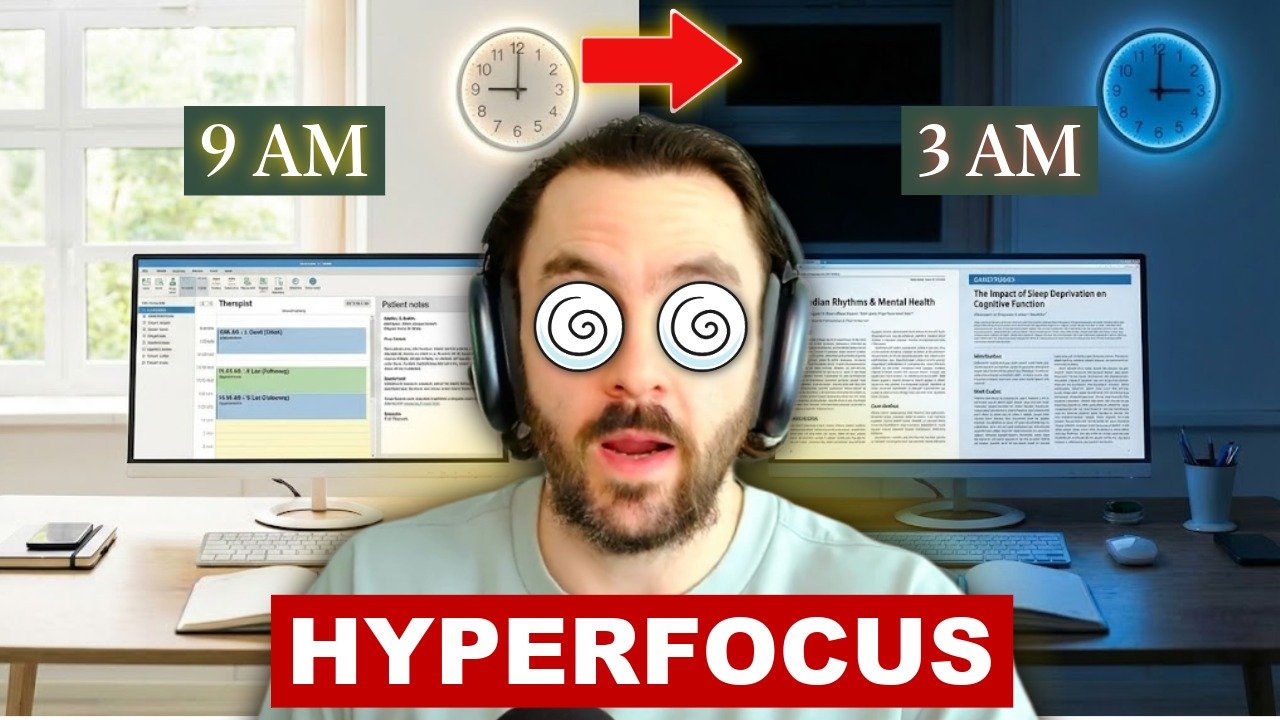
🔹 Time blindness — three hours can pass and genuinely feel like twenty minutes
🔹 Resistance and distress when asked to stop — frustration, anxiety, even irritability
It's not stubbornness. It could be ADHD.
Is Hyperfocus Always a Problem? ⚖️
Not always. Some people describe hyperfocus as their superpower — a flow state where they produce incredible work in a short burst of time. A designer who completes a full project in one marathon session. A writer who generates 3,000 words before lunch. In those moments, hyperfocus can feel like a gift.
But here's the critical distinction: with ADHD, hyperfocus tends to focus on the wrong thing at the wrong time.
You might hyperfocus on finishing a novel the night a work report is due. You might spend four hours organizing one drawer while the rest of the apartment stays untouched. You might lock into a video game while your partner is in the next room waiting for you.
The activity itself isn't the problem. It's the timing, the context, and the ripple effects that follow.
How Hyperfocus Shows Up in Real Life 📋
At Work or School 💼
This is where hyperfocus creates some of its messiest consequences. The issue isn't that you can't focus — it's that your focus gets hijacked.
You might skip a required task entirely because something else grabbed your attention. You might spend hours perfecting one section of a project while the rest goes neglected. You might lose half the workday to something that wasn't on your to-do list at all — and the worst part is, the thing you hyperfocused on might actually be excellent. But if it wasn't what was asked for, it still creates problems.
In Relationships ❤️
Hyperfocus doesn't clock out when you leave the office.
When you're locked in, you become genuinely unaware of the people around you. A partner asking for help. A friend waiting for a reply. A child pulling at your sleeve. The hyperfocus isn't a sign that you don't care — but from the outside, it can look exactly like that. Over time, the pattern creates real strain: less presence, less connection, less time actually invested in the relationship.
In Personal Life 🌱
Other responsibilities have a way of quietly piling up while hyperfocus takes over. You pick up a guitar for "just a little while" and surface two hours later to a full inbox and a sink full of dishes. You start a home project and miss an entire evening with your family.
There's also the deeper loss: missing the present moment. You're on a day off, at a birthday party, on vacation — and instead of being there, you get pulled into something else entirely. Hours pass. The moment is gone.
What Can You Do About It? 🛠️
Here's the good news: hyperfocus is absolutely manageable. It takes awareness, planning, and a handful of practical tools — and it's something our therapists work on with clients in ADHD therapy in New York every single day.
1. Start With Distress Tolerance 🧘
This is the step people most often skip — and it's the most important one.
Stepping away from hyperfocus feels bad. Not "mildly annoying" bad — genuinely distressing. Anxious, irritable, frustrated. That's real, and it's a major reason why willpower alone doesn't work.
The goal isn't to eliminate the discomfort. It's to build your capacity to tolerate it. When you know the discomfort is coming and you've prepared for it, it loses a significant amount of its power over you.
2. Create an Obnoxious Exit Strategy 🚨
When you're deep in hyperfocus, a gentle nudge isn't going to cut it. The interruption needs to be loud, disruptive, and hard to ignore — something that cuts through the tunnel and gives you a moment to consciously choose what happens next.
What works:
🔹 Loud phone or smart speaker alarms set well in advance
🔹 Asking a partner, roommate, or coworker to physically interrupt you
🔹 A combination of both
The method matters less than the volume. Make it impossible to miss.
3. Rehearse for the Discomfort Ahead of Time 📅
The best time to prepare for hyperfocus is before it happens. Once you're in it, your ability to self-regulate drops significantly — you're already in the tunnel.
If you know you tend to hyperfocus on emails at end of day, prepare the night before: "Tomorrow at 5 PM, I'm going to feel frustrated when I stop. That's okay. Here's exactly what I'm going to do." That mental rehearsal turns a reactive, out-of-control moment into a planned one. It's a small shift — but it's a powerful one.
4. Build a Ramp-Down Period 🛤️
Transitions are genuinely hard for ADHD brains. Going directly from full hyperfocus to a completely different task is like hitting the brakes on a highway at full speed — jarring, and it usually doesn't work.
Instead, think of it like an off-ramp. If you need to leave the office by 5:00, stop your task at 4:40. Use those 20 minutes to gradually ease down: take a short walk, grab a snack, sit and breathe. Nothing elaborate. Just buffer time between "deep in it" and "moving on" — with something calming filling that space.
You Don't Have to Navigate This Alone 💙
Understanding hyperfocus is one thing. Building the habits, tools, and self-awareness to actually manage it in real life? That takes support.
At PRGRS Therapy, we specialize in virtual ADHD therapy across New York State — serving clients in New York City and throughout the state with evidence-informed, personalized care. We don't believe in one-size-fits-all advice. We believe in understanding your brain and helping you work with it, not against it.
You're the one doing the hard work. We're just here to help you find the path.
Schedule your free consultation today.
