
Executive Function and ADHD, Explained in Plain Language
The first time I heard the term "executive function," I pictured people in business suits. Corner offices, the C-suite, somebody with an assistant keeping their calendar straight.
That was entirely wrong.
Here's what executive functions are, how they connect to ADHD, and the one approach we come back to with clients more than any other.
What executive functions actually are
Dr. Russell Barkley, a leading researcher in the field, points out that there are a ton of definitions floating around. He boils it down to something you can hold in one sentence:
Executive functions are the mental abilities you need to work toward goals.
Barkley then splits the executive fuinctions into seven internal executive functions and five external ones. There's some overlap between the two lists.
The seven internal executive functions
1. Self-awareness. The ability to direct your attention inward and observe yourself.
2. Inhibition. Self-restraint, in other words. Stopping your immediate reaction so you have time to think before you act.
3. Nonverbal working memory. Holding visual pictures and mental maps in your mind to guide yourself.
4. Verbal working memory. Your internal voice, the one you use to talk yourself through something, give yourself instructions, and problem solve.
5. Emotional self-regulation. Managing, soothing, and moderating your feelings.
6. Self-motivation. Generating your own internal drive to finish something when there's no outside reward waiting for you.
7. Planning and problem solving. Mentally playing with information and ideas to find new ways around an obstacle.
The five external executive functions
1. Self-restraint. Managing your impulses and your actions.
2. Time management. Monitoring yourself against the passage of time and against deadlines.
3. Self-organization and problem solving. Arranging your environment so it works efficiently, and adapting when things don't go the way you planned.
4. Emotional self-regulation. Managing your moods, and not going off like a firecracker at ordinary things happening around you.
5. Self-motivation. Activating yourself to start something and stick with it until it's done.
What makes one internal and the other external
The internal ones are the things nobody around you can observe.
Inhibition is a good example. When you stop yourself from saying the thing, nobody watching sees that happen.
The external ones show up in the world. Self-organization is visible: people can see how you've arranged your environment to help you get where you're going. The sticky notes on the monitor, the way the kitchen is set up, the calendar that runs your week.
Barkley's Swiss army knife
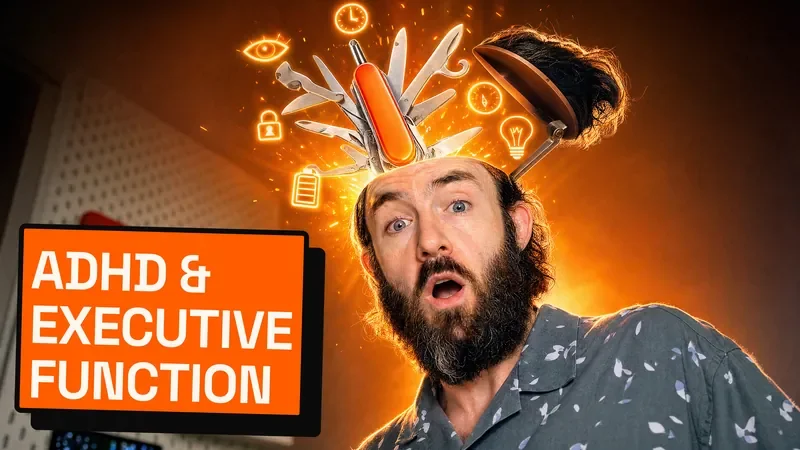
The metaphor Barkley uses for all of this is a Swiss army knife: a set of different tools you deploy depending on what the moment asks for.
Say you're in a loud restaurant having a conversation that matters. You reach for inhibition to block out the noise around you and hold your attention on the person across the table.
Or an email lands from your boss with a brand new problem in it. You go quiet for a minute and start turning it over in your mind . Maybe I call this person. Maybe I pull the report first. None of that is visible from the outside. You're playing with ideas in your head to solve something new, which is planning and problem solving doing its job.
Different situation, different tool.
And the definition holds through all of it: executive functions are the set of skills you use to work toward your goals.
So how does this connect to ADHD?
This is where it gets important, because the connection is much tighter than most people realize.
ADHD isn't loosely related to executive function. ADHD is a developmental disorder of executive functioning. People with ADHD experience pervasive executive dysfunction across many areas of life, and it directly involves the internal and external functions listed above.
Read the DSM criteria with executive function in mind and it becomes obvious. Take one of the hyperactive criteria: "often blurts out an answer before a question has been completed." That's inhibition, described in different words.
Go through the criteria for both the hyperactive and inattentive presentations and you'll notice almost all of them are describing executive functions. Not adjacent to them. Describing them.
Which means the difficulty was never about caring enough or trying hard enough.
What actually helps: externalizing
If your executive functions are affected, the obvious question is what to do about it.
There's real research on strengthening executive function skills, and we're proponents of that work. But the idea we bring up with clients constantly, the one that tends to pay off the fastest, is externalizing your executive functions.
Take memory. Rather than pouring all your effort into remembering better, build a system that holds the memory for you. A notepad on your phone. A wall of sticky notes. The method genuinely doesn't matter. What matters is that the remembering now happens outside your head, where it isn't competing with everything else.
Or take context switching, which is a hard one for a lot of people. Stopping one task and starting another can feel close to impossible.
Instead of trying to get better at making that turn, set an alarm before you start. Put the phone in another room. Time it to go off when you need to stop, not when you feel like stopping. When it goes off, you have to physically get up to deal with it, and that walk creates the space that lets you move to the next thing.
You didn't white-knuckle the transition. You built it into the room.
Worth saying one more time, because both halves matter: we encourage strengthening and skill building around executive functions, and at the same time we want people thinking about how to externalize them. When those two run together, people tend to do very, very well.
Key takeaways
Executive functions are the mental abilities you need to work toward goals. Seven are internal, five are external, with some overlap.
The internal ones happen where nobody can see them. The external ones people can see.
Think of them like a Swiss army knife. Different situations call for different tools.
ADHD is a developmental disorder of executive functioning. Read the DSM criteria closely and nearly every one is describing an executive function.
Strengthening these skills helps. Externalizing them, moving the work out of your head and into your environment, often helps faster. Do both.
Where to go from here
Progress Therapy is a group practice specializing in ADHD. We're based in New York City and work virtually with clients across New York State, and executive function is most of what we do. If you'd like to talk it through with someone who knows this territory, reach out here.
You can also watch the full video if you'd rather hear this one out loud.
