
Is It Anxiety or ADHD?
Someone is tapping their foot under the table through an entire meeting. Are they anxious? Do they have ADHD? Do they have both? How can we know?
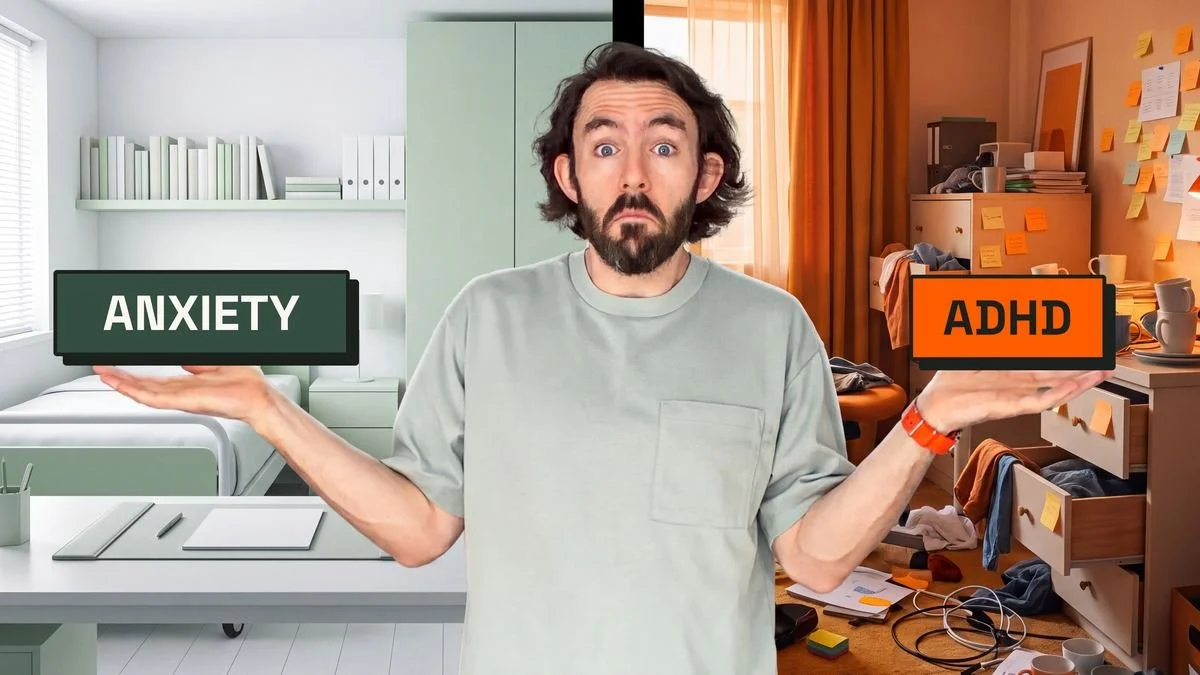
That is the whole difficulty with anxiety and ADHD in one image. On paper, the two look remarkably alike, and they get confused constantly. It makes sense that they do. But the confusion has real consequences, because what helps one is not necessarily what helps the other.
In this article we will break down the difference between anxiety and ADHD, talk about why they get confused, and what we can do about it. Let’s go.
DSM Criteria
The DSM, the Diagnostic and Statistical Manual, is the set of criteria mental health providers use to make diagnoses. Worth saying up front: this is not everything, and it is not perfect. It is a very imperfect science. But having a clear set of criteria to look at makes the differences much easier to see, so that is where we will start.
One narrowing before we go further. Anxiety comes out in all sorts of different ways, and generalized anxiety disorder, or GAD, is not the only shape it takes. For the sake of this comparison, we will use the GAD criteria, because it will help us see the differences.
The symptoms, side by side
From the Generalized Anxiety Disorder entry, a handful of the symptoms listed are:
Excessive anxiety and worry.
Keyed Up or On Edge
Easily fatigued.
Difficulty concentrating, or mind going blank.
Irritability.
Muscle tension.
Sleep disturbance.
Hold these in mind. 🧠
From the ADHD criteria, a sampling rather than the full list. Starting with inattentive type:
Often fails to give close attention to details or makes careless mistakes in schoolwork, at work, or during other activities.
Often has difficulty sustaining attention in tasks or play activities, for example difficulty remaining focused during lectures, conversations, or lengthy readings, which may include unrelated thoughts.
Moving to hyperactive type:
Often fidgets with or taps hands or feet, or squirms in their seat.
Often "on the go," acting as if "driven by a motor." For example, unable to be or uncomfortable being still for extended time, as in restaurants or meetings, which may be experienced by others as restless or difficult to keep up with.
Read those two lists back to back and something jumps out. Nearly every symptom named on the anxiety side is reflected somewhere on the ADHD side. That is only a sampling of the ADHD criteria, and it already covers most of the anxiety list.
Which is exactly why people with ADHD so often get handed an anxiety label instead. It can run the other direction too, and it is entirely possible to have both. But in my own experience seeing people in practice, the confusion often is with thinking ADHD is anxiety.
Three examples of the overlap in life
Excessive worry. Plenty of people with ADHD are genuinely anxious and worried. The worry is real. But look at where it comes from: being behind on things, feeling like you are never ahead of the curve, tasks piling up with no end, procrastination, the work never quite getting done. There is a clear reason sitting underneath it. Observed from the outside, that looks exactly like anxiety.
Restlessness. "Feeling restless, keyed up, or on edge" sits in the anxiety criteria. People with ADHD hyperactive type also feel restless, as the criteria for that describe. But it is not coming from worry. It is an internal need to move, the thing the manual describes as feeling driven by a motor. On the surface these look identical.
Irritability. This one is interesting, because there is no clearly corresponding ADHD criterion. Irritability is not named there. But emotion regulation is genuinely harder with ADHD, and that has largely to do with executive functioning. ADHD is an impairment of the executive functions, and the executive functions are part of what helps us regulate emotion. So what happens for a lot of people is that regulating emotion takes far more effort. Sometimes that shows up outwardly, sometimes it turns inward. Either way, from the outside it reads as irritability, and that can get mislabeled as anxiety as well.
Why the wrong label matters
If you are observing someone from the outside, or you do not know them well, or you are not particularly familiar with ADHD, the mislabel happens easily. And it matters, because the treatment and the whole approach can be very different depending on which one you are actually working with. Someone can spend a long stretch working hard on the wrong thing.
This is not only a risk in casual conversation. It happens in therapists offices too. There are many mental health providers, and not all of them are familiar with ADHD. A provider who is not can mislabel just as readily as anyone else. If you are looking for an ADHD therapist NYC has plenty of clinicians, and far fewer who have actually trained in this specifically.
What can we do?
What to do with any of this?
Do the research, broadly. Read and watch widely, and be selective about sources. Learn as much as you can about ADHD
Then bring it to someone trained specifically in ADHD. Not just any provider. Someone with real experience in it. This is the actual trick, because there is a lot of nuance here and the overlap is genuinely hard to sort from the outside. Once you are talking with someone who knows this territory, you can start having real conversations about what you have been experiencing.
For people looking into ADHD therapy New York wide, it is a completely fair question to ask a prospective therapist what their ADHD training is before you book. The answer tells you a lot.
The alarm and the engine
Anxiety and ADHD can produce the same tapping foot, the same restless meeting, the same evening spent worrying. The overlap is not in your head, and being confused about it does not mean you have missed something obvious. The criteria genuinely do overlap, which is why this deserves more than a quick glance.
PRGRS Therapy is a group practice based in New York City specializing in ADHD, offering virtual ADHD treatment New York State wide. If you live in New York and any of this sounded familiar, the link to the practice is below and we would be glad to talk it through with you.
