
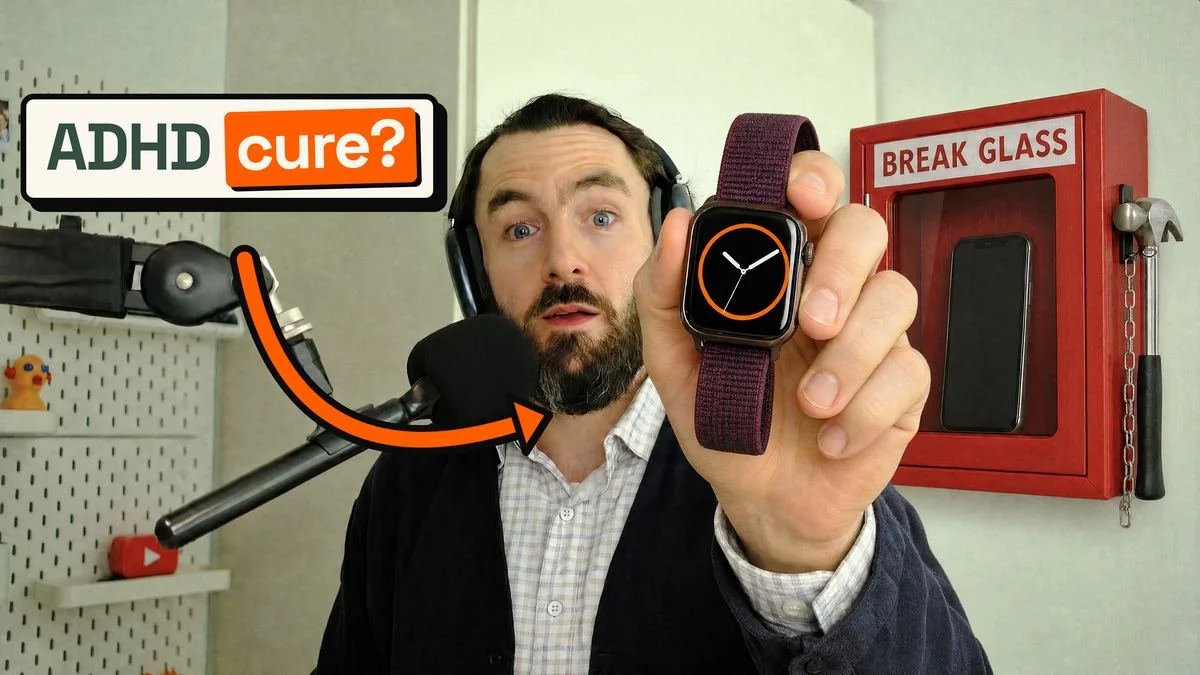
Spoiler alert. No. An Apple Watch can’t cure ADHD, but it can really help. For years I refused to get an Apple Watch. My phone already buzzed in my pocket, my computer buzzed on my desk, and the last thing I wanted was something buzzing on my wrist too. No thank you! I don’t want to live in a beehive.
However, I eventually caved when I no longer wanted to run with my phone. I was tired of heading out with my phone bouncing around in my pocket and notifications cutting into the middle of a run. Not to mention the new phones are basically the size ipads. So I caved and bought an Apple Watch, purely so I could leave the phone at home while I ran.
This turned out to be one of my best decisions this year. Leaving the phone home on runs turned into leaving it home allmost all the time. Now I rarely travel with my phone. There have been a ton of benefits. A few major ones are increased productivity and spending more meaningful time with family.
So, will an Apple Watch cure your ADHD? No. But it can really help with one of the most common struggles we see… doom scrolling.
Why doom scrolling hits harder with ADHD
Doom scrolling isn't an ADHD-only problem. Almost everyone has picked up their phone to check one thing and looked up way later than they meant to.
With ADHD, though, a few executive function challenges make doom scrolling worse.
Time blindness. Ten minutes and an hour can feel exactly the same while you're scrolling.
Hyperfocus. Once your brain locks onto the feed, it can be really hard to pull it away.
Impulsivity. The phone comes out of your pocket before you've even decided to take it out.
Put those together and the pull to start a scroll session can feel irresistible. That makes sense given how an ADHD brain is wired. It's not just a willpower problem. Oh yes, not to mention the tech companies designing the apps are paying tons of money to keep you on them longer. The odds are stacked against us!
What it ends up costing
This goes without saying, but some of the issues doom scrolling causes include:
Lost time you meant to spend on something else
Feeling awful afterward 😩
Trouble at work
Strain in relationships
Diminished attention span.
The catch: your phone is also your lifeline
If doom scrolling were the only thing your phone did, the answer would be simple. Get rid of it.
But that's not realistic. Most of us need to be connected to function day to day. Your phone is how you reach friends and family, how you get directions, how work email finds you, and a hundred other things.
It's like having to walk past the candy aisle every single time you need groceries. You have to go in, and the thing you're trying to avoid is right there on the way to the milk. The same device that causes massive problems also solves a ton of them. That's exactly why it's so hard to manage.
Why the Apple Watch works: friction plus access
Here's the unlikely fix: an Apple Watch with cellular. Put the phone in a drawer, strap on the watch, and head out the door.
It works because of two principles, and both of them apply to most strategies you'll build for ADHD.
1. It adds friction to what you want less of
On the watch, the things that eat my time are either gone or much harder to get to:
No YouTube
No social media
No firing off quick replies to every email and text
And then there's the part nobody loves, but would benefit from: I have to sit with some boredom. Standing in line with nothing to look at. Going for a walk with nothing in my hands. The quiet moments with my family, like riding the bus together, where I used to reach for my phone without thinking. That friction is the whole point.
2. It keeps access to what you need
This is what makes it different from ditching your phone altogether. If I really need something, it's still right there on my wrist:
Texts and calls
Email
Calendar
Directions
Voice recorder
Notes
You don't have to brick your phone or throw it out. You get the peace of mind of knowing you can reach what matters, without the doom scrolling stuff riding along. In a lot of ways it's the best of both worlds. Honestly, it's a relief.
What changed when I left my phone at home
Here's what I've noticed since the watch replaced my phone for most of the day:
I'm more present. More quality time with my family, my friends, and whatever I'm actually doing.
My brain is getting comfortable with boredom. And my attention has gotten better because of it.
I get more done.
I go to bed on time (most of the time), and I'm waking up earlier.
I spend more time on things that fill me up, like reading, writing, and hobbies.
My days are more planned. If I'm not bringing my phone, I have to think ahead about what I'll need. That little bit of forethought shapes the whole day.
It's not about the watch
I'm not here to sell you Apple products. I'm sharing a strategy that has worked for me, because the principle underneath it is one we come back to again and again in our ADHD therapy: increase the friction around the things you want to do less of, and keep the things you need within easy reach.
The watch is just one way to do that. If you're looking for ways to cut back on doom scrolling or social media, it might be the right option for you. The friction is what does the work.
If you'd like help building strategies like this around how your brain actually works, that's what we do. PRGRS Therapy is a group practice of ADHD therapists in NYC, offering virtual ADHD treatment across New York State.
