
Combined Type ADHD: What It Actually Is In Plain Language
Combined type is one of the three presentations of ADHD laid out in the DSM-5.
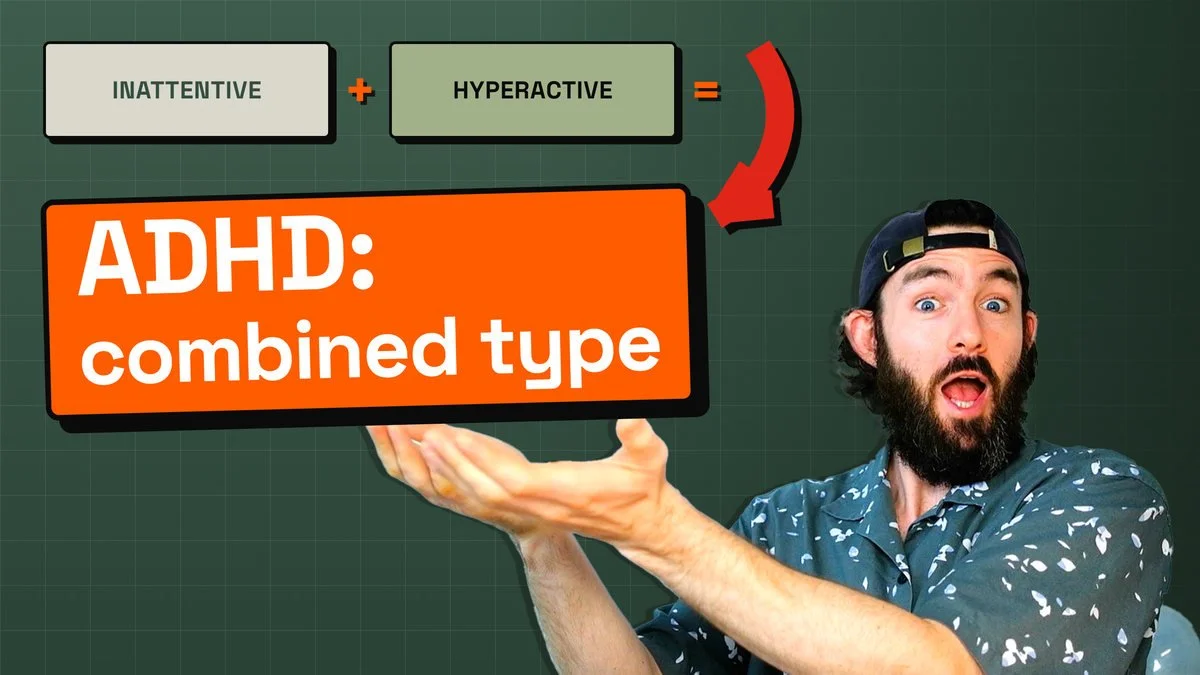
Here's the short version: it isn't a third, separate kind of ADHD. It's the label for meeting the criteria on both of the other two lists at the same time — the inattention and the hyperactivity-impulsivity.
Why "types" is in quotation marks
ADHD diagnosis are defined by the DSM-5. That manual lays out three presentations, and those three are where the word "types" comes from.
The quotation marks are doing real work, though. In practice ADHD doesn't sort itself into three tidy boxes. Someone can look one way at 9 and another way at 34. The categories are the shared language clinicians use to make a diagnosis. They aren't a perfect description of how anyone experiences their own life.
Both things are true at once: it's the system we have to identify ADHD, and it's tidier than the thing it describes.
The three “types” or presentations
Predominantly hyperactive/impulsive. The one most people picture when they hear ADHD — the kid who can't stay in the seat. That's a stereotype, and a narrow one, but it's the cultural default.
Predominantly inattentive. The one that tends to go unnoticed. Nothing about it disrupts a classroom, so nothing about it gets flagged.
Combined. Both.
The threshold: six and six (more on that below)
The DSM-5 splits the symptom criteria into two sets — nine symptoms under inattention, nine under hyperactivity and impulsivity.
For either set, the requirement is identical. This is directly from the DSM.
Six (or more) of the following symptoms have persisted for at least 6 months to a degree that is inconsistent with developmental level and that negatively impacts directly on social and academic/occupational activities.
For combined type, people have to have six or more on both lists. In other words 12 or more criteria need to be met.
The nine inattention criteria, verbatim
a. Often fails to give close attention to details or makes careless mistakes in schoolwork, at work, or during other activities.
b. Often has difficulty sustaining attention in tasks or play activities.
c. Often does not seem to listen when spoken to directly.
d. Often does not follow through on instructions and fails to finish schoolwork, chores, or duties in the workplace.
e. Often has difficulty organizing tasks and activities.
f. Often avoids, dislikes, or is reluctant to engage in tasks that require sustained mental effort.
g. Often loses things necessary for tasks or activities.
h. Is often easily distracted by extraneous stimuli.
i. Is often forgetful in daily activities.
The nine hyperactive-impulsive criteria, verbatim
a. Often fidgets with or taps hands or feet or squirms in seat.
b. Often leaves seat in situations when remaining seated is expected.
c. Often runs about or climbs in situations where it is inappropriate.
d. Often unable to play or engage in leisure activities quietly.
e. Is often "on the go," acting as if "driven by a motor."
f. Often talks excessively.
g. Often blurts out an answer before a question has been completed.
h. Often has difficulty waiting his or her turn.
i. Often interrupts or intrudes on others.
Both sets carry the same note: the symptoms can't be solely a manifestation of oppositional behavior, defiance, hostility, or a failure to understand instructions.
The four additional criteria
It showed up before age 12. Less a hard cutoff than a question about these issues trancending your lifespan rather than just a season.
It turns up in two or more settings. If something happens only at work and nowhere else, the honest first question is about the job. When it travels with you — work, home, friendships, parts of life with nothing to do with each other — that's different information.
It actually interferes. There's a difference between having symptoms and having impairment. This criterion asks about the second: whether these things are reducing the quality of how you function socially, academically, or occupationally.
Nothing else explains it better. Anxiety looks like this. Depression looks like this. So do several other things, and so does ordinary life-stage change. Ruling them out is a real part of the work, and it's most of why this needs someone trained rather than a list on a website.
Almost everyone will recognize something here
Read those eighteen symptoms and you'll find some of yourself in them. So will nearly everyone you know.
That's not a trick, and it isn't a reason to distrust the criteria. It's what happens when clinical language describes ordinary human behavior — the words for "loses things" and "interrupts people" are the same whether it's a lifelong pattern or a chaotic Tuesday. The list can't tell those apart. That's the clinician's job.
Which is the honest limit of an article like this one. Recognizing yourself in a list is real information and a good reason to make an appointment. It isn't an evaluation.
Nobody experiences this as eighteen numbered items anyway.
What to do if this sounds like you
Find someone who knows ADHD. Not just any mental health professional — one who works with ADHD regularly. Plenty of good clinicians don't, and the difference matters more than people expect going in.
Hear their recommendation. Someone who knows this territory can tell you whether a formal assessment makes sense and what kind, instead of you triangulating from a symptom list.
Then treat it. A diagnosis isn't the finish line — it's what makes a real plan possible. When ADHD is identified properly and the plan is built around it, people can do well.
If you are interested in working with professionals who know ADHD well reach out to us today.
