
Can a little notebook cure ADHD phone addiction? I don't know about cure. But what's inside it could seriously cut down your screen time, and if it can do that, why not give it a try?
Spoiler alert… it's a simple habit tracker. Paper, a pen, a roler (optional), and a grid of boxes. That's the whole thing.
I know how that sounds. Too simple, ridiculous even. Stick with me, because there are real reasons a tool this simple can work for your brain.
Before you start: two ground rules
Commit to actually trying it
Not every skill or tool works for everyone. Some click and some don't. What happens a lot, though, is that people write a tool off before they ever really use it. Maybe they tried it once. Maybe they heard about it and felt skeptical.
I'm guilty of this myself. When I don't think something will work, I can reject it on the spot without opening my mind to it at all. I don't want that for you.
So make a small commitment: give this a week or two with an open mind. Then come back and decide whether it worked.
You're not going for perfection
This goes for every skill and tool I teach. The goal isn't to do it perfectly. The goal is to raise your odds of success. If a tool improves your chances even a little, it may be worth your time.
What the tracker looks like
Check out the video to see the actual paper layout: https://youtu.be/S6eiZLVHBtI
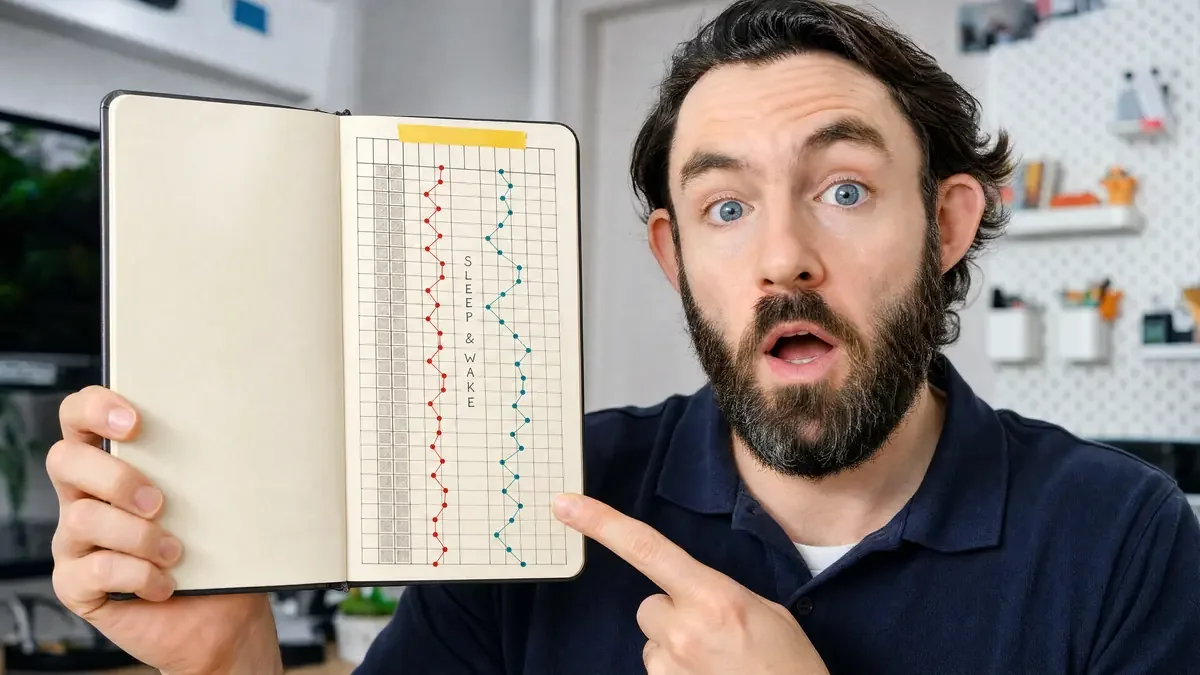
Open the notebook and you'll see a simple grid.
A title at the top. For example, the month you're tracking, like November.
The days across. Count out a box for each day of the month, from 1 to 30 or 31.
Your habits down the side. One row per thing you want to track.
What you track is up to you. A few ideas:
Less than 25 minutes of screen time
Reading
Bedtime on time
Then, each day you hit the habit, you fill in that day's box. Miss a day? Leave it empty and keep going. Hit it the next day? Fill it in. ✏️
And there's something about filling in that box. It feels so satisfying, and it never gets old.
Why something this simple can work
You might be thinking this is way too simple to make a difference. Here's why it can.
1. It adds friction to your phone
When it comes to ADHD skills and tools, we lean on a couple of principles: reduce the friction around things you want to do more of, and increase the friction around things you want to do less of.
This tracker increases friction around your phone. If you track your habits in an app, you have to pick up your phone to do it, and we all know how that can go. On paper, your phone can stay put away.
It pairs really nicely with my last blog, about swapping my phone for an Apple Watch. Same idea: when the phone is in a drawer, it's much harder to reach for, and your screen time goes down. 📱
2. It builds in a little accountability
I don't share my tracker with anyone. I'm accountable to a little box on a page. That sounds silly, I know.
But when I go to pick up my phone, I find myself thinking: if I pick this up and get stuck, I won't get to fill in that box. That small thought is often enough to change what I do next.
3. It gives you a reward
Remember the sticker chart from school, and how good it felt to get that sticker? Filling in a box taps into the same feeling. Completing a tracker can feel really gratifying, and that reward gives your brain a reason to come back tomorrow. ⭐
It doesn't have to be forever
Is a paper tracker going to be your solution for the rest of your life? Probably not. If it helps you get the ball rolling for a week, a month or two months, and reducing screen time starts to become a habit, that's a great way to get started.
It's also very easy to start. You don't need a fancy notebook. Grab any piece of paper and a ruler and draw the grid by hand.
Give it a week
Pick one habit, draw your grid, and fill in your first box tonight. Then give it a week or two before you decide.
If you'd like support building tools around how your brain works, that's what our ADHD therapists in NYC do every day. Progress Therapy offers ADHD therapy in New York, virtually across the state. Contact us today.
