
Think about the difference between an individual running coach and a running club.
A coach watches your stride, builds your plan and notices things you can't see yourself. A running club does something else. It gives you a handful of people who are expecting you on Saturday morning, who've hit the same wall at mile four, and who'll share their experience with you.
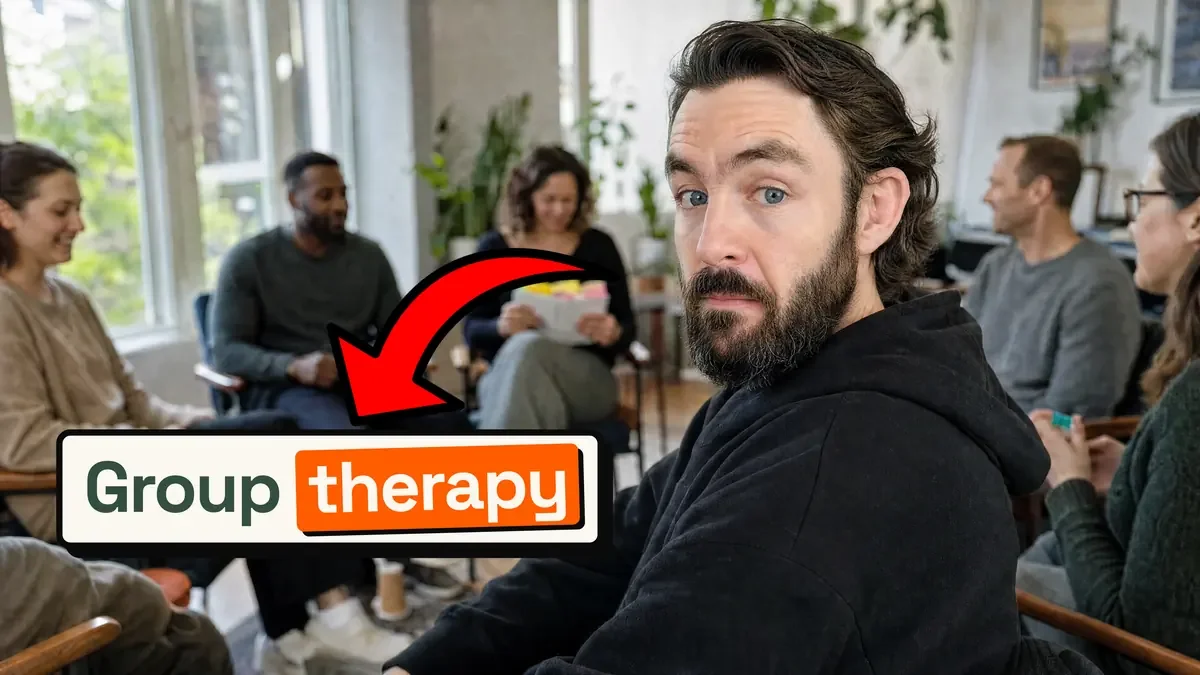
Group therapy for ADHD is like the club. It isn't a replacement for the coach. It's a different kind of support, and for a lot of people it fills a gap that one-on-one therapy can't.
What group therapy actually looks like
A lot of people picture group therapy from TV and movies. Some of those depictions are accurate. Many aren't.
Groups can get complicated, and there are all sorts of them. To keep it simple most groups you'll come across fall into one of three types. 🧭
Process-oriented groups
This is what most people imagine. People share what's going on in their lives and how they're feeling, and the group works through different emotions and thoughts together. Every group has structure, but a process-oriented group is usually the least structured of the three.
Skill-focused groups
Here a skill is being taught, and people are there to learn it. Part of it is fairly didactic, a bit like a class. You still talk the skill through together, but learning and acquring skills is the main goal.
Semi-process groups
Then there's the blend. Sometimes called a semi-process-oriented group, it mixes learning skills with time and space to process, discuss and explore. Our new ADHD group sits here. Skills get taught and practiced, and there's room to talk about how they're landing in real life.
Why a group can help with ADHD
So does group therapy work for ADHD? At PRGRS Therapy, we think it can be very helpful. Not every type of group will be, but a group built around ADHD has some real advantages. Here are some of the main benefits.
1. You learn skills that fit how your brain works
A key part of high-quality ADHD care is skills: learning tools to better manage executive function, or how to work with the EF deficits. A skill-focused or semi-process group gives you a place to hear about skills, learn them and practice them, week after week. 🛠️
2. You learn from peers, not just from a professional
Learning from a therapist, a group facilitator or an ADHD coach is one thing. Learning from someone who isn't any of those is another.
Picture a group where everyone shares what they do about procrastination. You're going to walk away with some pretty good ideas, and they come from people living it, not from a handout.
3. You get validation and empathy from people who get it
There's something powerful about hearing "me too" from a person who knows what it's like to live with the same challenges. A group gives you a space to receive that validation and empathy from people who understand your experience in a way others might not. 💚
4. Accountability is built in
Accountability helps most people. With ADHD and executive function challenges, it tends to be extremely helpful for a lot of people.
Once you're in a group, you're accountable to the other members: to show up, to come prepared, to try the homework or whatever the group is working on. You don't have to create that accountability yourself. It's already there.
5. It's a safe space for trial and error
This is one of my favorite things about groups. You learn a skill, try it out for the week and figure out what worked and what didn't. Then you come back, adjust and try again.
That loop of try, report back and tweak is how a tool goes from "sounds good in theory" to something you actually use.
6. A therapist is guiding the room
In our practice, groups are facilitated by one of our therapists. The facilitator is there to teach the skill, moderate the discussion and provide oversight.
Not all therapists are equal, of course. Ideally you have a therapist who knows ADHD well and keeps the group focused on it, but who's also aware of other things that could be going on.
7. It's a place to practice emotion regulation
People don't think about this one often. Any group brings together different people and different personalities. Sometimes someone's share might stir up frustration, or sadness, or a sense of being overwhelmed. The group dynamics themselves can bring up all kinds of feelings.
That's not a flaw in the group. It's an opportunity. Within that context you now have a safe space to practice regulating emotions as they come up, with support in the room. It won't apply to everyone, but for the people it does apply to, it's a really great benefit. 🌱
Does group therapy replace individual therapy?
Most of the time, no. Everyone is different, but group usually works best as an add-on to individual therapy rather than a substitute for it.
Back to the running analogy: the club keeps you showing up and learning from others, and the coach tailors the plan to you. Together they cover a lot more ground than either one alone.
So, is a group worth it for you?
If you're curious about working with an ADHD therapist in NYC or anywhere in New York State, including our new group, learn more about PRGRS Therapy by booking a free consult.
